Over the past decade and especially the past year, we have seen the quiet yet incremental influence of the top 1% on almost everything in our lives. For instance, pop culture is morphing into pop capitalism, where every other celebrity is trying to sell a product that is completely unrelated to their craft. Capitalism’s role is also very notable in politics, where billionaires give insurmountable sums of money to politicians, all to keep the world the perfect habitat for their hidden monopolies. Capitalism being used as a political weapon like this may seem to be a new issue, but in reality, it has been festering under our noses for over a century. Since the Gilded Age of the 19th century, robber barons (an appropriate title for unethical businessmen) have paid off politicians to influence legislation. A specific example of this is the famous Crédit Mobilier Scandal of 1864-1867, in which Union Pacific Railroad executives created a fraudulent construction company, Crédit Mobilier, and then bribed U.S. Congress members with discounted stock to ensure favorable legislation. With a country like ours, one that was created with equality in mind, it is almost amusing to look back and figure out how this was ever allowed to happen here.

Historically, the wealthy have always used their monetary advantages for criminal immunity and control. This took place globally, emphasized in Europe by the feudal system and the inequality it sustained. However, with the beginning of the United States and the so-called “democracy”, that was supposed to change. Everyone was supposed to be equal; to have a fresh start. However, like the great dystopian author George Orwell once wrote in his famous novella Animal Farm: “Some are more equal than others.”
By the 20th century, certain individuals took advantage of rising industries: railroads, oil, and finance–and because history always repeated itself, the wealth gap grew significantly here as well. These 1900s billionaires tried to be a bit kinder than those of the past by donating small parts of their wealth. Most notably, the billionaire steel magnate, Andrew Carnegie, who funded the construction of Carnegie Hall (but still named it after himself, of course). But these donations were not out of the kindness of their hearts, at least not fully; they were appeasement. Carnegie and others like him still created and led monstrous monopolies that affected not only their workers but the job markets altogether.

Andrew Carnegie at a work desk. Photo: Marceau, NYC
However, as evil as I make them sound, back then, there were maybe 3 or 4 billionaires; it was easier to keep them at bay. Today, we have thousands. We only really began to see more than 10 billion dollar net worths when the technology industry erupted in the 1990s. Billionaires are rising steadily in numbers, from 13 in 1982 to 1,990 in 2025. And these people don’t just spend their money on yachts and fancy weddings in Venice (cough cough…Jeff Bezos)–they spend millions in lobbies and funding political campaigns. This sustained growth in the number of billionaires and their global influence highlights the dangers of having citizens with vast wealth without effective control over it.
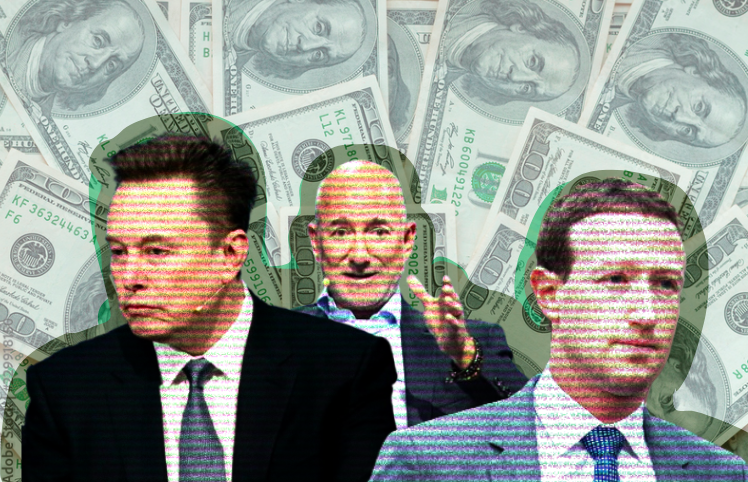
Our current president has a net worth of 5 billion dollars; he also has eight cabinet members who are billionaires, and the net worth of his cabinet is estimated to be 14 billion dollars (excluding former cabinet member Elon Musk), writes Timothy Noah in the New Republic article, “How the Billionaires Took Over America,” published June 2025. The main reason for our concern is exhibited in exactly this: the political sphere does not condemn but instead promotes this vast wealth inequality. If our own president and his cabinet have upwards of $10 billion, why would they feel sympathetic about how we are negatively impacted by billionaires? They themselves are not even affected; on the contrary, they benefit. Trump’s campaign was almost entirely funded by the America PAC (Political Action Committee), created by Elon Musk with the sole goal of electing Donald Trump, which it achieved (while funding nearly all of his campaign, approximately $240 million). PACs like this one are not the only issue, though. Billionaires also use their money to sponsor lobbies, pay off politicians, and bribe justices.
These political “donations” aren’t a new issue, but in the past couple of decades, they, along with monetary political corruption in general, have taken a completely new form, largely due to the 2010 Supreme Court case Citizens United v. Federal Election Committee. The ruling ended donation limits for campaigns. This was rationalized by spending being classified as a “First Amendment right,” so corporations not being able to support specific politics to their chosen extent would be “a limit on their free speech.”
Naturally, this has led to unimaginable increases in political spending: “In 2024, Super PACs set a record of $2.7 billion spent on the election,” according to Daniel Weiner in his article “Citizens United, Explained” published January 2025. This record-breaking performance exhibits how far wealthy people are willing to go to achieve their political desires, especially when their spending has no limit. They always tend to use their wealth advantage to promote certain politicians and interest groups, especially those that blatantly benefit from the coddling of the one-percenters. With such a description, who comes to mind more than our president, Donald Trump? The man who pretends to care about the people, but in reality spends 25% of his presidency golfing. It is an extremely unfair advantage that we allow the people who are least affected by Trump’s horrible policies to use this wealth advantage they have to elect him, just so that he can take away more of our money and give it to them.

Photo: USA TODAY Sports via ReutersL Jasen Vinlove
We as consumers must stop funding billionaires’ lavish lifestyles, but also must take on some responsibility to end their political obstruction. Due to their lobbies and bribes, it no longer matters what the people want from the democracy, despite its original purpose to be a beacon of equality and representation: “by the people for the people.” Through the rich muffling our voices, our democracy becomes by the rich for the rich, exactly what we have always feared. It’s not our democracy anymore, it’s theirs.
Quickly, the question has changed from “What can we do about this?” to “Can we even do anything about this?” In situations like these, it is very easy to look on bleakly and say the future is out of our hands, that billionaires are untouchable. Most billionaires’ wealth is in their stocks or in the companies and things that they own, objects inaccessible to us. Taking away some of the billionaires’ wealth and providing equality seems like the just thing to do, but it’s very difficult to tax non-physical items.
Despite this, I implore you to change your outlook. Although billionaires are up in their metaphorical ivory towers that seem to crush all beneath them, these towers that allow billionaires to be sheltered and safe from the harsh realities of life are only built and sustained by our hard-earned dollars. I’m not saying to pull the rug out from under them; that would be entirely too difficult. I am saying that maybe we should start cutting it up so it gets smaller, and their support lessens. Stop buying from them here and there; you don’t NEED that thing on Amazon, you just really want it. That’s how they have built their fortunes, by convincing us we need things we absolutely don’t. So remind yourself how much you already have, and don’t give them your well-deserved paycheck; they won’t even notice anyway. Another seemingly small but impactful action is to reach out to those who allowed this injustice in the first place. Email your federal senators, email the Indiana senators, email the governor, and tell them your grievances. The only way for this truly to be reversed is for enough people to express their outrage. Although Citizens v. FEC getting overturned seems unlikely, especially in our current climate, we can still make our voices heard. Make them hear us. We can try to crumble the tower, even if it seems unbreakable.