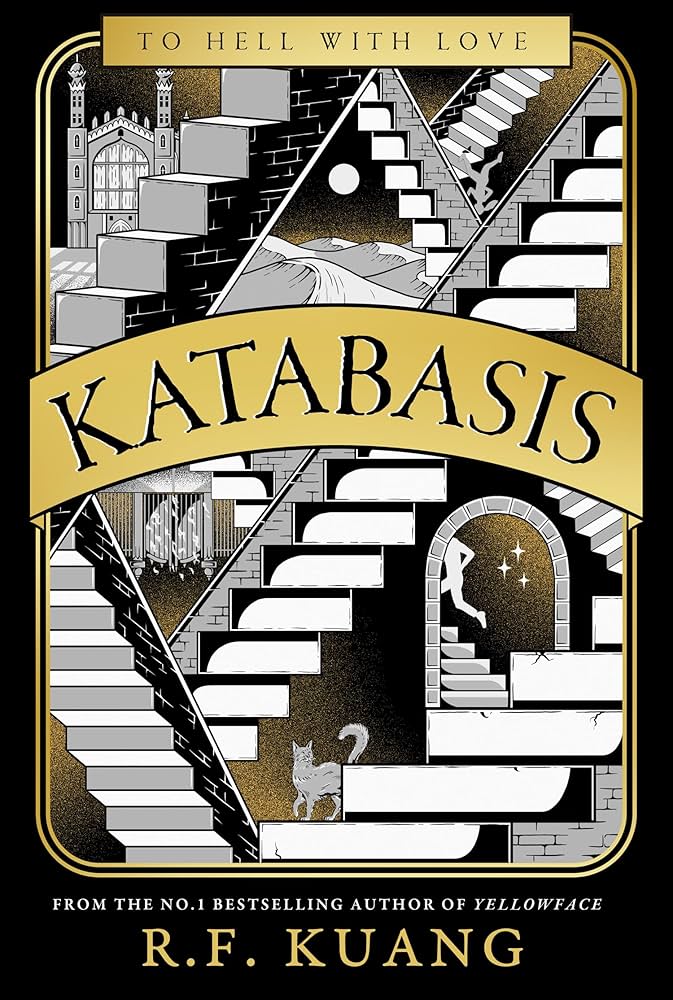
R.F. Kuang seems unsatisfied with existing within the bounds of traditional fantasy. She accomplishes massive literary feats, while still creating engaging novels that challenge every other book that has been published in the last decade. Babel, her 2022 release, is a masterpiece of language and learning, and works with Katabasis, which came out in August of this year, as two sides of the same coin. They both explore the gnarly and wondrous trials of academia. She also seems to be attracted in a passionate way to learning, more than other novelists writing today. In this book, the romance is not necessarily just to a specific person, but for a general theme of a love of life and the joy of the absorption of knowledge.
Named for the Greek phrase for the descent into the underworld, it follows Alice Law as an undergraduate student studying ‘magick’ under an acclaimed professor. When she accidentally kills him, she and her friend Peter Murdoch journey to Hell to get recommendations for the scarce job opportunities the field has. Alice is studying a particular branch of magick—‘analytical,’ seemingly in contrast with ‘continental’ magick, as they are purportedly in direct opposition of each other, although that is never mentioned explicitly in the book. Analytical philosophy mainly comes from England, and it emphasizes systematic logic and intense reasoning and argumentation sometimes backed by mathematics. Continental philosophy comes primarily from France and Germany, and the opposite of analytical—It is based on analysis outside the intense analysis, and is more about language and history. The book incorporates examples of real analytical philosophy—like the sorites paradox mentioned early in the book. Part of the love of learning is the love of brute logic, an unadulterated instance of reasoning working in a beautiful way.
As the book progresses, the reader learns more about Alice’s graduate school experience, and the reason why she decided to take the harrowing journey down to Hell—the sheer amount of effort she poured into this field, and why she pays a price for the trip.
Since the Divine Comedy was written in the 14th century, there haven’t been many attempts at cataloguing, and, undoubtedly, Katabasis is more concerned with raising a conversation about the hoops graduate school makes students jump through; it does, however, engage in the joys of a literary tradition. For one, R.F. Kuang isn’t trying to re-capitulate or reinvent the Divine Comedy. If anything, Kuang’s hell is more of an extended allusion of Dante, while being a simultaneous fusion of traditions about the underworld. It feels like George Saunder’s Lincoln in the Bardo in its embrace of western and eastern traditions about death. Much like watching a star baseball player in their element; reading Katabasis is watching a superstar doing just what she excels at.